

Burning the Script: How Ruby Sparks Deconstructs the "Perfect" Partner
a Moving Screen review

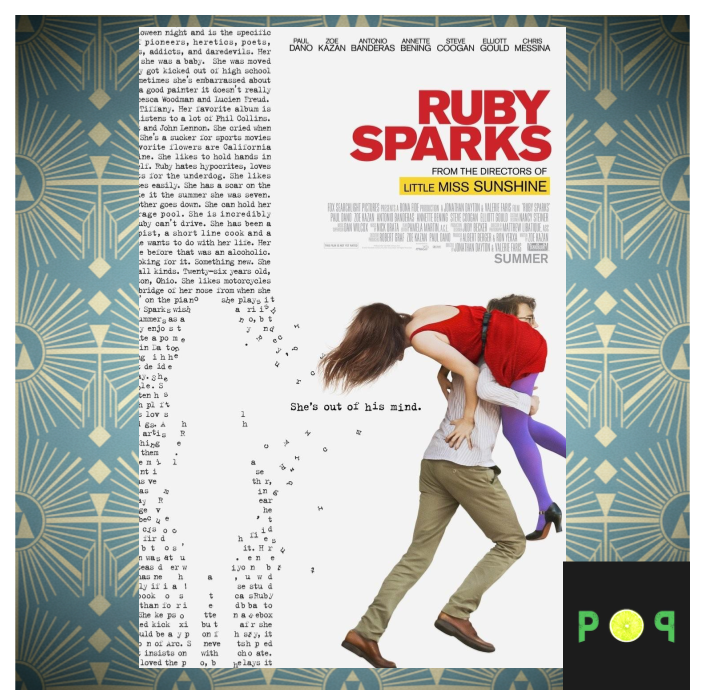
The premise of Ruby Sparks (2012) feels like the kind of high-concept lightning bolt that strikes every writer at 3 AM: What if you could literally write your dream partner into existence?
It’s a “logline” I’ve carried in my own head for years, yet somehow this film stayed under my radar until now. Having finally caught up with it, I realized that while the hook is brilliant, the execution is something far more profound—and uncomfortable—than a simple indie rom-com.
The Writer’s Ultimate Power Trip
The setup is a novelist’s fantasy. Calvin (Paul Dano) is a literary wunderkind suffering from the sophomore slump. Battling a massive case of writer’s block, he begins having vivid dreams about an imaginary girl. He does the only thing a writer can do: he puts her on the page.
Then, the impossible happens. Ruby (Zoe Kazan) is standing in his kitchen making breakfast.
The genius of the film is that it never stops to explain the “how.” There’s no magical typewriter or cosmic alignment. It simply accepts the impossibility and lets the human consequences run their course.
A Feminist Treatise in Rom-Com Clothing
The “meta” layers here are where Ruby Sparks gets truly interesting. Zoe Kazan actually wrote the screenplay and cast her then-real-life partner, Paul Dano, as the lead.
While Calvin is our protagonist, Ruby is the soul of the film. Through her, Kazan delivers a sharp critique of the “Manic Pixie Dream Girl” trope. It’s a feminist deconstruction of how men perceive their wives and girlfriends—often as idealized extensions of their own needs rather than autonomous humans.
When Calvin realizes he can change Ruby’s personality or mood simply by typing a new sentence, the film pivots from a whimsical romance into a dark exploration of control.
Beyond Gender: A Universal Mirror
While the feminist angle is undeniable, I’d argue the film’s reach is even broader. It serves as a bold analysis of any romantic relationship.
We all “write” versions of our partners in our heads. We fell in love with a projection, and the friction in a relationship usually begins when the real person starts to deviate from the script we’ve written for them. Ruby Sparks just makes that literal. It asks: Can you love someone you can’t control?
The “Perfect” Resolution
The film sticks the landing with a rare precision. The ending provides a full resolution that feels earned rather than forced.
The defining moment—“Let’s start again”—is pure genius. It acknowledges that for any relationship to actually survive, you have to burn the “script” you’ve created for the other person and meet them exactly as they are, without the weight of your expectations.