

The Multiverse Before It Was Cool: Why ‘Fringe’ Still Sticks the Landing
a Moving Screen recommendation

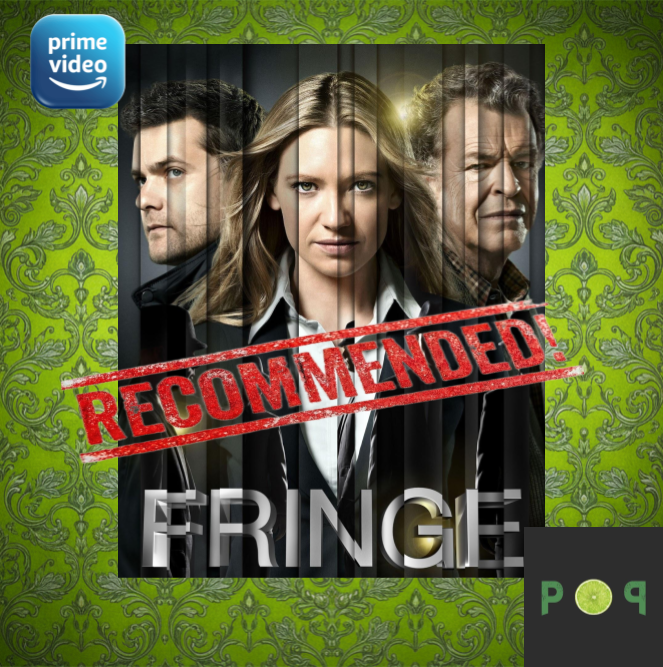
In the current streaming landscape, we’ve become accustomed to the “eight-episode movie.” We get tightly coiled, high-production seasons that often vanish from the cultural conversation as quickly as they arrived. So, sitting down to rewatch all 100 episodes of Fringe (2008–2013) felt like a radical act of endurance.
But here’s the thing: it didn’t feel like a chore. It felt like a masterclass.
When J.J. Abrams, Alex Kurtzman, and Roberto Orci launched Fringe, the initial reaction was predictable: “It’s just an X-Files rip-off.” On the surface, it was. We had the FBI agent (Anna Torv’s Olivia Dunham), the skeptical consultant (Joshua Jackson’s Peter Bishop), and the “mad” scientist (John Noble’s Dr. Walter Bishop) investigating “The Pattern”—a series of bizarre, often horrific phenomena.
But looking back with a decade of perspective, Fringe didn’t just borrow the X-Files blueprint; it fixed the foundation.
The Art of the Pivot
Most series that run for 100 episodes eventually hit a plateau. They become caricatures of themselves or get lost in their own mythology (looking at you, Lost). Fringe avoided this by being fearless with its own status quo.
The show’s trajectory is a fascinating study in narrative evolution:
Seasons 1-2: The Procedural. A solid “Monster of the Week” format that quietly planted the seeds of something much larger.
Seasons 3-4: The Multiverse. Long before the MCU made “variants” a household term, Fringe was executing a complex, high-stakes war between parallel realities. This is where the show truly ascended, challenging the cast to play dual versions of their characters with subtle, heartbreaking nuances.
Season 5: The Dystopia. In a bold final move, the show leaped into a future occupation struggle, pivoting from speculative science to a gritty resistance drama.
The Walter Bishop Factor
You can have the most complex multiverse in fiction, but without an emotional anchor, it’s just math. John Noble’s performance as Walter Bishop remains one of the greatest achievements in genre television.
Walter isn’t just comic relief or a plot device to explain the “pseudo-science.” He is the show’s moral core—a man seeking literal and metaphorical redemption for a “hubris-driven” mistake that fractured two worlds. The chemistry between Torv, Jackson, and Noble turned what could have been a cold procedural into a story about a broken family trying to find a version of “home” that still exists.
Sticking the Landing
We’ve been burned too many times by sci-fi finales. Usually, they either crumble under the weight of unanswered questions or retreat into vague, spiritual ambiguity.
Fringe did neither. It stuck the landing with a surgical precision that was both logically sound and immensely resonant. It gave us a happy ending that felt earned, not gifted. It respected the 100 hours of time we invested by ensuring every character arc reached its natural, poignant conclusion.
Why You Should Watch It Now
If you were to produce Fringe today, it would likely be spread across ten seasons of “prestige” TV. There is a density to these 100 episodes that feels rare in the modern era. It’s a series that respects the tropes of classic sci-fi while having the confidence to subvert them.
For the sci-fi and horror buffs who haven’t revisited the Fringe Division lately—or for those who missed it entirely—it’s currently streaming on Amazon Prime Video.
In an era of disposable content, Fringe remains essential viewing. It’s speculative fiction with a heart, a brain, and a remarkably clear vision of its own ending.