

The Sci-Fi Oddity Where Jack the Ripper Thought 1979 Was Utopia: Revisiting ‘Time After Time’ (1979)
a Moving Screen analysis

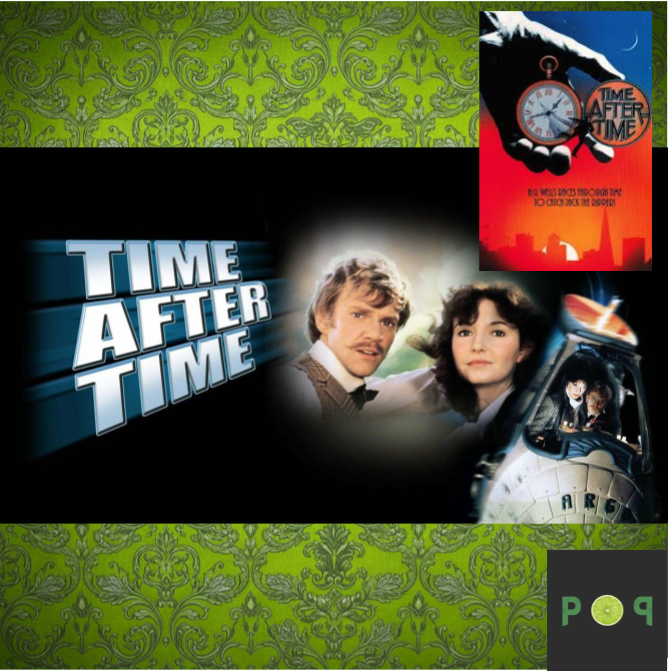
There are movie premises so perfect, so utterly irresistible, they demand to be made, regardless of the plot holes they might carve in the space-time continuum. Time After Time (1979) is one of those films.
It’s the debut feature from director Nicholas Meyer (who would go on to revitalize the Star Trek franchise), and it’s built on a spine-tingling hook: What if H. G. Wells (played with stiff Victorian propriety by Malcolm McDowell) had a functional time machine, and what if he had to use it to chase his worst nightmare - Jack the Ripper (a mesmerizing David Warner) - into 1979?
That setup alone is enough to sell a thousand tickets. But as we look back, Time After Time isn’t a flawless masterpiece; it’s a brilliant, beautiful oddity - a film whose core themes resonate more strongly today than its mechanics do.
When the Time Machine Forgets the Rules
The story begins in 1893 London, where the Ripper escapes police capture by stealing Wells’s newly invented time machine and rocketing forward a century. Wells, driven by a sense of responsibility, follows him. And this is where the first, most glaring cinematic speed bump occurs.
As established in the source material, Wells’s invention was a Time Machine, capable only of moving in time, not space. Yet, somehow, the device, and its occupants, end up deposited directly in 1979 San Francisco. The film’s attempts to explain this geographical leap are flimsy at best, relying on cinematic convenience rather than sci-fi logic. For a genre that thrives on internal consistency, this is a tough pill to swallow, and it immediately sets the film apart as a curiosity rather than a narrative powerhouse.
Another element that pulls focus is the central romance. Once in the future, Wells quickly encounters Amy Robbins (Mary Steenburgen), an efficient and forward-thinking bank employee. Steenburgen is charming (and would famously reprise a time-travel love interest role years later in Back to the Future III), but much of the movie’s middle section is dedicated to developing their relationship. While the romance is essential to ground Wells’s journey in the new era, it does get tedious, sometimes sidelining the central, thrilling race against history’s most infamous killer.
David Warner’s Chilling Utopia
Where Time After Time truly excels is in its thematic confrontation - a battle of ideals more compelling than the pursuit itself. This is entirely due to David Warner’s phenomenal performance as Jack the Ripper.
Warner plays the Ripper, Dr. John Leslie Stevenson, not as a cackling villain, but as an intellectual predator. Upon arriving in 1979, he is confronted with the violence, the cynicism, and the casual brutality of the modern era. And he is delighted.
“I have seen the future, and it works,” he chillingly remarks, realizing he is a man truly in his element. This 1979 landscape, far from the polished utopia Wells had envisioned, is a place where his crimes are not anomalies, but just part of the background noise.
The contrast is devastating: H. G. Wells, the visionary author of progress, is heartbroken to see his future is a pipe dream, a technological but moral wasteland. The man he is chasing, the ultimate symbol of the 19th century’s darkness, finds freedom and fulfillment in the modern world. This is the film’s stroke of genius—a profound commentary on the disillusionment of the post-war era.
Time After Time is undeniably an oddity: structurally flawed, occasionally slow, but built on a premise so clever and featuring a thematic battle so chilling, it becomes mandatory viewing for anyone who loves the time travel genre. Go watch it, if only to see the moment Jack the Ripper decides the future belongs to him.
Did you catch this one back in the day? Let me know your favorite flawed sci-fi masterpiece in the comments!